

The UK government has confirmed plans to introduce mandatory electronic invoicing for VAT invoices from 1 April 2029, marking a significant step in the country’s digital tax transformation.
The policy follows a government consultation on promoting electronic invoicing across UK businesses and the public sector and forms part of a broader effort to modernise tax administration and improve VAT compliance.
While the deadline may appear several years away, the introduction of mandatory e-invoicing will require businesses to modernise how invoices are issued, received and processed. Organisations that rely on PDFs or manual invoice workflows today will need to transition to structured digital invoicing that can be exchanged directly between financial systems.
This guide explains what the upcoming UK mandate means, the expected timeline, and how businesses can begin preparing now.
What Is E-Invoicing?
E-invoicing refers to the structured electronic exchange of invoice data directly between systems, allowing invoice information to be automatically captured and processed by accounting or ERP software.
Unlike a PDF or image invoice sent by email, a true e-invoice contains structured data that can be validated and processed automatically without manual data entry. The UK government’s consultation on promoting e-invoicing explains that electronic invoices enable invoice data to be exchanged digitally between businesses, improving efficiency and reducing administrative costs.
Because the data is structured, the receiving system can automatically check required fields such as supplier information, invoice totals and VAT amounts. This allows organisations to automate invoice capture, validation and posting within their finance systems.
If you want a deeper explanation of how structured invoicing works, see our Guide to E-Invoicing.
Why the UK Is Introducing Mandatory E-Invoicing
The UK’s move toward e-invoicing reflects a wider global trend in tax digitalisation. Governments are increasingly introducing structured invoicing requirements to improve transparency, reduce fraud and modernise tax reporting systems.
Digitalising tax administration
Mandatory e-invoicing aligns with the UK’s broader strategy to digitalise the tax system. Initiatives such as Making Tax Digital (MTD) aim to transform how businesses keep records and interact with HMRC by moving tax reporting to digital platforms.
The government’s consultation on e-invoicing notes that wider adoption of digital invoicing can improve accuracy in tax reporting and reduce administrative burdens for businesses.
Improving efficiency for businesses
Beyond tax compliance, structured invoicing can also improve operational efficiency. Electronic invoices can be validated automatically, reducing manual processing and the risk of errors.
Industry bodies such as the Chartered Institute of Taxation have highlighted that wider adoption of e-invoicing could help improve productivity and modernise invoice processing for UK businesses.
For many organisations, the mandate will therefore act as a catalyst for broader finance transformation and automation initiatives.
UK E-Invoicing Mandate Timeline
The UK’s e-invoicing policy is still being designed, but several key milestones have already been announced.
Key milestones
In 2025, the UK government launched a consultation exploring how electronic invoicing could be promoted across businesses and the public sector.
The consultation gathered feedback from businesses, industry bodies and technology providers on potential models for implementing e-invoicing.
Following this process, the government confirmed that mandatory e-invoicing will be introduced from 1 April 2029.
In early 2026, HMRC began working with stakeholders to design the final framework for the mandate and determine the technical standards required for implementation.
Additional policy detail and implementation guidance are expected as the programme develops.
Scope of the UK E-Invoicing Mandate
Under current plans, the UK mandate will apply to VAT invoices issued in B2B and B2G transactions.
This means businesses will need to be able to both issue and receive structured electronic invoices when trading with other VAT-registered organisations.
Consumer transactions are not currently expected to be included in the scope of the mandate.
Public sector context
Electronic invoicing is already used in parts of the UK public sector procurement ecosystem. In particular, some public sector supply chains use the PEPPOL network, an interoperability framework that enables structured invoices to be exchanged between organisations.
The new mandate will expand structured invoicing requirements beyond these existing use cases and into the wider business landscape.
The Likely Technical Model for the UK
Although the final framework for mandatory e-invoicing in the UK is still being developed, the government has indicated that it is considering interoperable models that allow businesses to exchange electronic invoices through their chosen service providers rather than requiring a single government platform.
The government consultation on promoting e-invoicing asked stakeholders to provide views on several possible approaches, including interoperable exchange models where businesses can send and receive e-invoices through different software providers.
Such models are commonly referred to as interoperability frameworks, where service providers can exchange structured invoice data between systems using agreed technical standards. These frameworks allow businesses to continue using their preferred accounting or finance platforms while ensuring invoices can still be exchanged electronically.
Digital reporting
At present, the UK consultation focuses primarily on promoting the adoption of electronic invoicing between businesses, rather than introducing real-time reporting of invoice data to HMRC.
The consultation document states that the government is exploring how to increase adoption of electronic invoicing across the economy and is gathering evidence on possible implementation models.
Because the policy framework is still being developed, the final technical model and reporting requirements will be determined following further consultation and collaboration with businesses, tax professionals and software providers.
For now, organisations should monitor updates from HMRC as the government develops the final framework for the UK’s e-invoicing mandate.
How the UK Mandate Compares to Europe
Across Europe, many governments are introducing mandatory e-invoicing and digital reporting systems as part of wider tax modernisation initiatives.
At EU level, the VAT in the Digital Age (ViDA) initiative aims to modernise VAT reporting and promote digital invoicing across member states.
Several European countries, including Italy, France and Germany, have already introduced or announced structured invoicing mandates.
Compared with these jurisdictions, the UK timeline is later. However, the policy reflects the same global shift toward digital tax infrastructure and automated invoice exchange.
For more information on other national mandates, see our guides to the Germany e-invoicing mandate and the France e-invoicing mandate.
What Businesses Should Do Now
Although the UK mandate will not take effect until 2029, preparing early can significantly reduce the disruption involved in transitioning to structured invoicing.
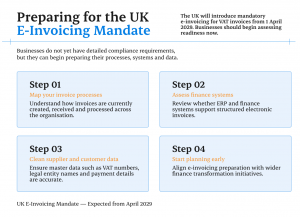
Assess current invoice processes
Start by mapping how invoices are currently created, approved and processed across the organisation. Identify areas where manual processing or PDF invoices are still used.
Evaluate technology readiness
Review whether your ERP or finance systems support structured invoice formats and digital invoice exchange.
Prepare supplier and customer data
Structured invoicing relies on accurate master data. Businesses should ensure supplier records contain correct legal names, VAT numbers and payment details.
Plan implementation early
E-invoicing initiatives often require cross-department collaboration between finance, IT and procurement teams. Starting early allows organisations to address data quality, system integration and supplier onboarding challenges well before the mandate takes effect.
Our Mandatory E-Invoicing Readiness Checklist outlines practical steps businesses can take to prepare.
It is also worth understanding the operational realities of large-scale e-invoicing projects before beginning implementation. Our article on Seven Realities of E-Invoicing Implementation explores common challenges organisations encounter during rollout.
Because e-invoicing regulations continue to evolve globally, organisations should also monitor how technical standards change over time. Our guide on how to stay ahead of changing e-invoicing standards explains how businesses can maintain compliance as new mandates emerge.
Preparing for the UK E-Invoicing Mandate
The UK’s move toward mandatory electronic invoicing marks an important step in the country’s ongoing digital tax transformation.
Although the full implementation framework is still being developed, the direction of travel is clear. Businesses will increasingly need to exchange structured invoice data electronically rather than relying on traditional PDF invoices or manual processing workflows.
Organisations that begin preparing early will be better positioned to adapt as the regulatory framework evolves. Assessing invoice processes, modernising finance systems and improving data quality now can significantly reduce the disruption involved in transitioning to structured invoicing.
Businesses can start by reviewing the practical steps outlined in our Mandatory E-Invoicing Readiness Checklist and exploring the broader principles behind structured invoice exchange in our Guide to E-Invoicing.
If you would like to understand how prepared your organisation is for upcoming mandates, contact us to arrange a readiness assessment. Starting the conversation early can help identify gaps in processes, systems and data before regulatory requirements take effect.
Frequently Asked Questions
The UK government has confirmed that mandatory e-invoicing for VAT invoices is expected to take effect from 1 April 2029. The policy follows a government consultation on promoting electronic invoicing across UK businesses and the public sector, and further implementation details will be developed through ongoing collaboration with industry.
An e-invoice is a structured electronic invoice exchanged directly between financial systems. Unlike a PDF or image invoice sent by email, an e-invoice contains machine-readable data that can be automatically validated and processed by accounting or ERP systems.
Current policy announcements indicate that the mandate will apply to VAT invoices issued in B2B and B2G transactions. Businesses will need to be able to both send and receive structured electronic invoices when trading with other VAT-registered organisations.
Many European countries have already introduced mandatory e-invoicing frameworks as part of broader tax digitalisation programmes. While the UK timeline is later than some EU countries, the policy reflects a similar trend toward structured digital invoice exchange and modernised tax reporting systems.
Even though the mandate will not take effect until 2029, businesses can start preparing now by reviewing their invoice processes, assessing whether their finance systems support structured invoices, and ensuring supplier and customer master data is accurate. Early preparation can make it easier to adapt once the final regulatory framework is confirmed.