
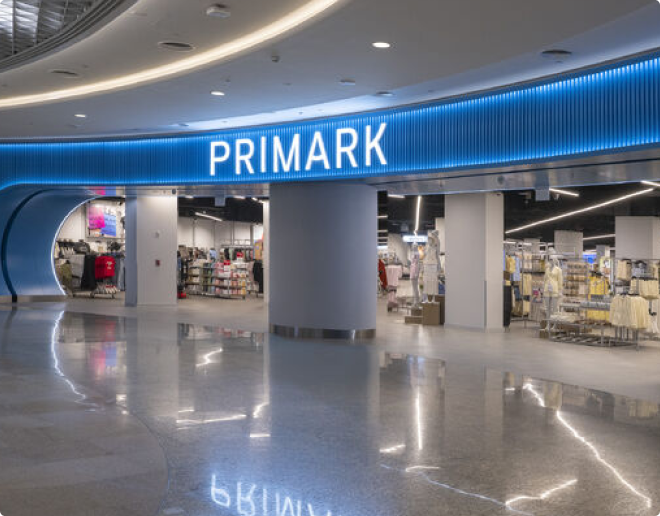
Project at a glance
Rapid international growth exposed the limits of Primark’s back-office systems. Their P2P process was heavily paper-based, inconsistent, and difficult to scale. Supplier payments were unreliable, visibility was low, and finance lacked the credibility needed to support the business.
- Rebuilt supplier trust through on-time payments
- Scaled P2P foundation for global expansion
- Improved accuracy, reporting, and financial control
- Reduced supplier queries and operational noise
When growth outpaced the finance process
Primark’s growth outpaced its finance operations. As the business expanded across markets, its back-office systems struggled to keep up. The P2P process was heavily manual and paper-based. Invoice handling was inconsistent, purchase orders were not embedded, and supplier payments were frequently delayed or disputed. The impact went beyond inefficiency. Supplier relationships were under strain, and finance lacked credibility across the business. Without reliable data or consistent processes, reporting was questioned and decision-making slowed. The day-to-day reality included:
- Paper-based invoice processing and manual matching
- Low control over supplier payments and PO usage
- High volume of supplier queries and disputes
- Limited trust in financial data and reporting
Fixing P2P before scalingthe business
Primark didn’t start with a full ERP replacement. They focused on fixing the foundation first. SoftCo automated the P2P process across invoice capture, matching, and approval, configured around how Primark operates across markets, suppliers, and currencies. The focus was practical. Get invoices processed. Get suppliers paid on time. Restore control over spend.
“We didn’t need a three-year ERP programme. We needed something that worked now.”
By strengthening P2P first, Primark created a reliable flow of data into the wider finance ecosystem. That reduced operational noise, improved reporting accuracy, and supported better decision-making across the business. The approach also supported change. Processes were standardised, behaviours shifted, and accountability improved across teams interacting with finance.
From operational friction to financial control
The transformation was operational and structural. Supplier relationships improved as payments became consistent and predictable. Query volumes reduced, and trust was rebuilt across a critical part of the supply chain. Internally, finance moved from reactive to reliable. With accurate, trusted data, reporting improved and decision-making accelerated. The function gained credibility at senior levels of the business. Crucially, P2P became a scalable foundation. Primark could continue expanding into new markets, confident that its finance processes could support that growth without adding complexity or headcount.
98% touchless processing
Invoices processed without manual handling
Scalable P2P process
Supports global retail operations
Consistent on-time payments
Improved supplier trust and reliability
Real-time financial visibility
Accurate, up-to-date reporting
Improved supplier relationships
Reduced friction and disputes
“If suppliers don’t trust you to pay on time, they’ll prioritise someone else. We needed a partner who would challenge us and help us get to the right solution.”
Maura Mulderry
Director of Financial Planning & Analysis, Primark
