
Germany’s E-Invoicing Mandate: Where Things Stand in 2026

AP & P2P Analyst

In Brief
- Businesses with €800,000+ turnover must issue invoices in a structured format by next year
- 2026 brought clearer guidance and a refreshed ZUGFeRD format
- Getting compliant early avoids fines and keeps cash flow moving smoothly
Germany’s shift to mandatory business to business e-invoicing has been unfolding in phases since 2025, and 2026 has brought some of the most concrete guidance yet on how the rollout will actually work in practice. Companies operating in Germany, or selling into the German market, should use this moment to confirm that their understanding of the rules, and their systems, are current.
A quick recap of the timeline
The mandate originates from Germany’s Growth Opportunities Act (Wachstumschancengesetz), which set out a phased path to mandatory structured e-invoicing for domestic B2B transactions. The schedule looks like this:
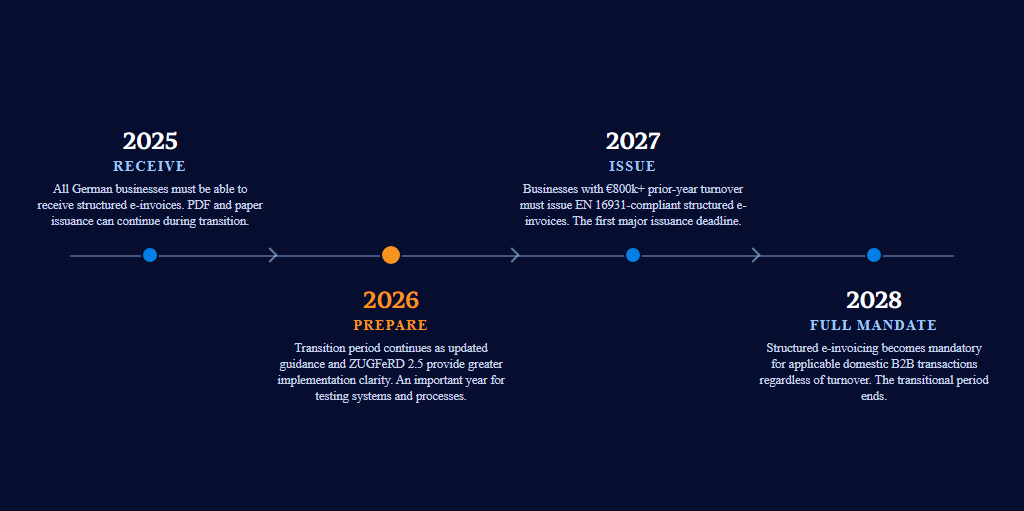
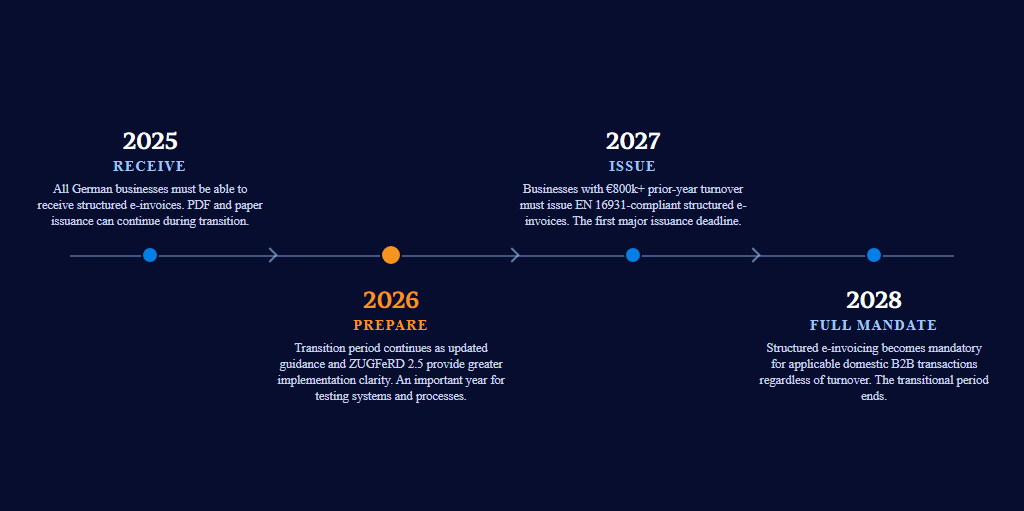
Since January 1, 2025, every business in Germany has had to be able to receive e-invoices in a structured electronic format. Recipients can no longer refuse a compliant e-invoice from a supplier, even if their own systems aren’t fully ready.
Through December 31, 2026, suppliers can still issue paper invoices or unstructured electronic formats (like a plain PDF), provided the recipient agrees. This is the transitional grace period for issuance, even though reception requirements are already live.
From January 1, 2027, businesses with prior year turnover above €800,000 must issue invoices in a structured format compliant with the European standard EN 16931. Smaller businesses, at or below that threshold, get an extra year and can keep using unstructured formats through the end of 2027.
From January 1, 2028, the transition completes: all domestic B2B invoices must be issued as structured e-invoices, regardless of company size.
What’s new in 2026
Two developments this year are worth flagging for anyone tracking the practical side of compliance.
In March 2026, the German Federal Chamber of Tax Consultants (BStBK) published an updated FAQ on electronic invoicing. It doesn’t change the legal timeline, but it fills in gaps that businesses and their advisors had been asking about, clarifying how structured e-invoices compliant with EN 16931 should be handled in practice, including the two formats Germany has settled on: XRechnung and ZUGFeRD.
On the format side, ZUGFeRD 2.5, the hybrid format jointly developed by Germany and France that embeds structured XML data inside a human readable PDF, began rolling out this year. The first component, published in June 2026, covered mandatory code list updates and preparatory technical changes. The more significant piece, which adds support for gross invoices (“Bruttorechnungen”) to serve industries like book trade, publishing, and petroleum, is still pending a second release once the revised EN 16931-1:2026 standard is formally adopted. None of this changes Germany’s rollout dates, but it does mean the technical specification underneath XRechnung and ZUGFeRD is still being refined even as the legal deadlines approach, which is worth knowing if you’re locking in invoicing software now.
Why this isn’t just a German story
It’s easy to read this as a single country compliance exercise, but it sits inside a much bigger EU wide shift. The European Union’s VAT in the Digital Age (ViDA) package, agreed at EU level, introduces its own Digital Reporting Requirements for cross border B2B transactions, taking effect July 1, 2030. That’s a materially different, and more demanding, obligation than Germany’s domestic mandate: it requires near real time transmission of transaction data to tax authorities, not just structured invoice formatting between trading partners.
Germany’s current mandate and ViDA are running on parallel tracks rather than one replacing the other. The practical implication is that structured e-invoicing adopted now for domestic compliance is a reasonable foundation, but it isn’t the finish line. EU member states, including Germany, are expected to align domestic systems with ViDA standards by January 1, 2035, so businesses investing in e-invoicing infrastructure today should be choosing systems flexible enough to absorb that next layer of reporting requirements rather than ones built narrowly around today’s rules.
What this means if you invoice into Germany
For businesses above the €800,000 turnover threshold, 2027 is closer than it feels. Structured e-invoicing isn’t a matter of swapping a PDF for a slightly different PDF. It means your invoicing system needs to generate machine readable XML (as in pure XRechnung) or a hybrid PDF/XML file (ZUGFeRD) that validates against the EN 16931 semantic standard. If you’re relying on manual invoice creation or older ERP export routines, this is the kind of change that takes months to test properly, not weeks.
For smaller suppliers under the threshold, the extra year of breathing room to 2028 is real, but it’s worth using proactively rather than treating it as a reason to wait. Trading partners above the threshold will be issuing e-invoices to you from 2027 onward, and your accounts payable processes will need to handle structured formats on the receiving side well before your own issuance deadline arrives.
For any business already selling software, ERP, or financial systems into the German market, the BStBK’s FAQ update and the ZUGFeRD 2.5 rollout are useful signals that customers are actively working through implementation questions right now. That’s typically when compliance driven purchasing decisions get made, well ahead of the hard deadline, once the “how” questions start outnumbering the “what” ones.
What non-compliance actually costs
German authorities have confirmed that no penalties apply during the current transition period, so a business still issuing paper or unstructured PDF invoices in 2026 is not at risk today. That changes once the mandate applies to a given business: 2027 for those above the €800,000 threshold, 2028 for everyone else. From that point, invoice and record keeping breaches under Section 26a of the German VAT Act (UStG) can attract fines of up to €5,000 per offence, with some categories of retention violation carrying separate, smaller penalties.
The bigger practical risk sits on the buyer’s side rather than the fine itself: once e-invoicing becomes mandatory for a transaction, input VAT deduction depends on having received a proper, valid electronic invoice. An incorrect or noncompliant invoice can hold up the recipient’s right to deduct VAT until a corrected version is issued. For finance teams, that turns a formatting requirement into a cash flow and reconciliation issue, which is a stronger reason to test invoicing workflows early than the administrative fine alone.
The practical checklist
A few things worth confirming before the end of 2026, regardless of company size:
- Your accounting or ERP system can both receive and validate XRechnung and ZUGFeRD files
- Whoever handles your invoicing understands the difference between the reception requirement already in force and the issuance requirements still phasing in
- Your software vendor has a stated roadmap for EN 16931-1:2026 compliance and the pending ZUGFeRD 2.5 update, not just the current baseline
The German mandate is a useful test case for a broader pattern playing out across the EU. Digital, structured invoicing is becoming the default state for B2B commerce, not an optional upgrade, and the businesses least disrupted by each new phase will be the ones that treated the transitional periods as implementation time rather than a countdown to ignore.

Frequently askedquestions
A phased legal requirement under Germany's Growth Opportunities Act for domestic B2B transactions to move to structured electronic invoicing. Since January 2025, all businesses must be able to receive e-invoices, with issuance becoming mandatory for larger businesses in 2027 and for everyone by 2028.
XRechnung is a purely structured XML invoice format, while ZUGFeRD is a hybrid format that embeds structured XML data inside a human readable PDF. Both are accepted under Germany's mandate as long as they comply with the EN 16931 standard.
Businesses with prior year turnover above €800,000 must issue structured e-invoices from January 1, 2027. Smaller businesses have until January 1, 2028, when the requirement applies to all domestic B2B invoices.
Once the mandate applies to a business, invoice and record keeping breaches under Section 26a of the German VAT Act can bring fines of up to €5,000 per offense. A noncompliant invoice can also delay a buyer's right to deduct input VAT.
Germany's mandate covers structured invoicing for domestic transactions, while the EU's VAT in the Digital Age package introduces separate digital reporting requirements for cross border B2B transactions starting July 2030. The two run on parallel tracks, with domestic systems expected to align with ViDA by 2035.