
Before you start e-invoicing: 7 realities from an implementation consultant

AP & P2P Analyst

This article reflects the implementation experience of Andrew Martin, Principal Consultant at SoftCo.
When organisations begin preparing for structured e-invoicing, the conversation usually starts with regulation and connectivity. In my experience, those are not the hardest parts.
What determines whether implementation feels controlled or chaotic is something more fundamental. It’s the quality of your data, the discipline of your processes, and how honestly you assess your operational readiness before invoices begin flowing.
If you are still getting to grips with the broader regulatory landscape, our comprehensive e-invoicing guide provides a useful overview of what is changing and why.
As an implementation consultant, here are seven things I tell clients before they start.
1. The regulation is not the hard part
Most teams assume the mandate will be the biggest challenge. They focus on formats, deadlines and how to connect to PEPPOL. Those elements are defined. They are manageable.
What organisations tend to underestimate is the operational impact. Structured e-invoicing does not tolerate the inconsistencies that PDF and email workflows quietly absorb.
In a PDF environment, you can get away with:
- Slightly incorrect legal names
- Missing identifiers
- Trading names used instead of registered entities
In a structured environment, those weaknesses surface immediately. PEPPOL does not create bad data. It exposes it.
Before thinking about transmission, I advise clients to ask a more basic question. Is our organisation and supplier data actually ready for structured validation?
For a broader view of readiness considerations, see our e-invoicing readiness checklist.
2. Data determines whether you succeed or stall
Data readiness is not a background task to be handled during testing. It determines whether invoices route correctly or fail.
Across implementations, the same issues recur:
- Missing or inconsistent supplier VAT or tax IDs
- Legal entity names that do not match registration records
- Duplicate or inactive supplier records that were never fully cleaned up
These problems don’t feel urgent until invoices start failing validation or landing in manual review queues. At that point, you are reacting rather than preparing.
In the first 30 to 60 days of any serious programme, I recommend focusing on a few practical steps:
- Audit organisation and supplier master data
- Confirm legal entity identifiers
- Align purchase order discipline with suppliers
It’s not the most visible part of the project, but it’s what determines how stable your go-live will be.
You can find more structured preparation guidance in our France e-invoicing mandate guide and our Germany e-invoicing readiness guide.
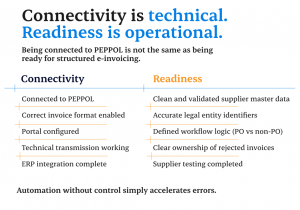
3. Connectivity is not readiness
Another common misconception is that once you’re connected to PEPPOL, you’re ready. Connectivity is only one layer.
Beyond compliance, organisations should ask themselves:
- Can we validate master data before invoices enter workflow?
- How does our system distinguish between PO and non-PO invoices when PO fields contain inconsistent data?
- What happens when an identifier is missing?
- Who owns rejected invoices and how are they resolved?
- Can our setup scale across entities or jurisdictions?
I’ve seen teams assume their ERP will manage everything automatically. Sometimes it can. Often it requires deliberate configuration of validation rules, workflow logic and exception handling.
If you automate without control, you simply automate errors faster. That’s why connectivity alone is not a meaningful measure of readiness.
4. Supplier behaviour will decide your exception rate
Many issues that surface at go-live are not technical failures. They are behavioural ones.
Supplier communication should begin early. In practical terms, that means:
- Providing clear guidance on required invoice fields such as VAT ID, PO format and legal entity name
- Sharing validation rules in advance
- Running testing phases with key suppliers
- Defining an escalation process for rejected invoices
To illustrate the impact, consider early feedback from one implementation environment:
- 13% of invoices required manual review because the supplier was not automatically recognised. This was linked to missing or inconsistent identifiers.
- 3% were routed to a holding area because no usable company name or tax identifier was present.
- A further portion contained mixed or incorrect data in the PO field. In non-PO cases, that field should have been left blank.
- In other instances, suppliers were entering PO numbers into free-text or description fields rather than the dedicated PO number field, meaning AP teams had to manually identify and rekey the reference before processing could continue.
None of these issues were connectivity failures. They were data discipline and change management issues.
Through a combination of supplier education and master data updates, there was potential to improve straight-through processing by approximately 35 percent.
Structured e-invoicing formalises standards that may previously have been informal. If suppliers are not prepared, exception rates rise. If they are engaged early, performance improves.
5. This is not a finance-only project
Successful implementations are cross-functional by nature.
IT must be involved early for integration and data mapping. Finance and AP teams need to define workflow rules and controls. Tax may need to clarify scope and regulatory interpretation.
When implementation is treated as a finance-only initiative, you often see:
- Weak ERP alignment
- Late discovery of master data gaps
- Unclear ownership of rejected invoices
E-invoicing changes how data flows across the organisation. It should be approached accordingly.
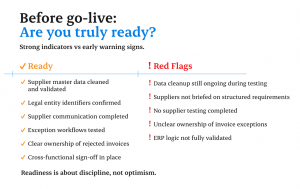
6. Know what good looks like before go-live
Readiness should be measurable, not assumed.
Strong indicators include:
- Cleaned and validated supplier master data
- Completed supplier communication
- Tested and clearly owned exception workflows
- Cross-functional sign-off with defined responsibilities
Red flags are equally clear:
- Ongoing data cleanup during final testing
- Unclear ownership of rejected invoices
- No supplier testing completed
A project can technically go live without resolving these issues. Operationally, however, it will struggle.
Readiness is about discipline, not optimism.
7. Make the right mindset shift early
If I had to distil this into one message, it would be this.
E-invoicing is not an IT integration project. It is a data integrity and process control transformation.
Connectivity is visible. Data discipline is quieter, but far more important. Organisations that treat this as an opportunity to strengthen governance and workflow control tend to stabilise quickly and achieve higher automation rates.
Those that treat it as a compliance checkbox often spend months resolving preventable exceptions.
Structured e-invoicing rewards preparation. The earlier you focus on data and process control, the smoother your implementation will be.
Not sure how ready you are? Start with an e-invoicing readiness assessment.
Frequently askedquestions
Master data is critical because structured e-invoicing systems validate supplier and organisation identifiers automatically. If VAT IDs, legal entity names, company registration numbers, or banking details are missing or inconsistent, invoices may fail validation or require manual review. Clean, validated master data directly improves straight-through processing and reduces disruption at go-live.