
How long does e-invoicing implementation actually take?

AP & P2P Analyst

When clients ask me how long e-invoicing implementation takes, the honest answer is: it depends, but probably not on what you think.
The technical setup, everything from configuring the connection, enabling PEPPOL to getting invoices flowing through the network, is straightforward. In most cases, the connectivity and platform configuration can be completed in a day or less.
What actually determines your timeline is everything that sits around it. The quality of your master data. The discipline of your supplier relationships. How clearly your organisation understands what structured invoicing demands of its own systems and processes.
This article shares what I’ve learned from implementing e-invoicing across enterprise environments: where time is really spent, what slows projects down, and what separates smooth implementations from difficult ones.
The question every organisation asks, and why it’s harder to answer than expected
Most organisations don’t approach e-invoicing with a detailed implementation plan. In my experience, the conversation usually starts with something simpler: “Germany requires us to accept e-invoices by January. Let’s get SoftCo involved.”
There’s rarely a deep consideration of formats, regulation or operational readiness at the outset. The assumption is that this is primarily a technical exercise: connect to the network, configure the system, and invoices will flow.
That assumption is understandable. But it’s also where timelines begin to stretch.
E-invoicing is often described as a format change: PDF replaced by structured data. In practice, it touches systems, governance, data quality and supplier relationships. Because these elements vary enormously across organisations, no two implementations follow the same timeline.
What organisations typically underestimate at the start includes supplier education, master data completeness, and the structured nature of PEPPOL file formats. PEPPOL and SoftCo accept the values provided. Validation occurs in SoftCo, but the success of processing depends entirely on the data that arrives.
For a broader view of what readiness involves, see our mandatory e-invoicing readiness checklist.
Connectivity is fast. Readiness is not.
This is a distinction I find myself making in almost every engagement.
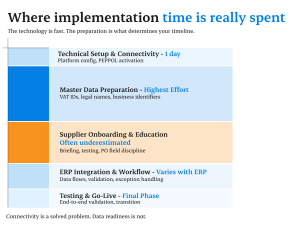
The activation and configuration of e-invoicing, including the transmission of files via the PEPPOL network to SoftCo, is quick, efficient and well-established. One day or less is generally enough to configure and put the technical elements in place. Connectivity, while a consideration, is not an inhibitor.
What takes time is everything the customer needs to have in order before that technical activation delivers value:
- Organisation details must be complete in the ERP; legal name, business identifiers, VAT registration numbers. If these are missing or inaccurate, invoices are held up immediately at the most basic level.
- Supplier master data needs to be clean. Missing or incorrect VAT IDs on supplier records prevent the system from identifying who the invoice is from. Where the organisation is detected but the supplier cannot be matched, manual intervention is required.
- Supplier behaviour needs to be understood. The most common issue I encounter is invalid entries in the PO number field on PEPPOL files. When a supplier populates that field on what should be a non-PO invoice, the invoice is automatically routed down the PO matching workflow, requiring manual correction.
- In other cases, suppliers enter PO numbers into free-text or description fields rather than the dedicated PO number field. This means AP teams have to manually identify and rekey the reference before processing can continue.
None of these are connectivity problems. They are data quality and process discipline problems. And they’re the reason that “how long does implementation take?” is rarely a simple question to answer.
As I wrote in our previous article on seven realities of e-invoicing implementation: if you automate without control, you simply automate errors faster.
A realistic enterprise implementation timeline
Enterprise e-invoicing implementation typically unfolds across several stages rather than a single technical deployment. The technical go-live is one milestone within a broader programme of work.
A realistic journey looks something like this:
- Regulatory clarity and scoping — Understanding which mandates apply, across which entities and countries.
- System landscape analysis — Identifying all ERPs and invoice-generating systems in scope.
- Master data preparation — Reviewing ERP data for completeness, accuracy and timeliness.
- Integration and configuration — Defining how invoice data flows between systems and SoftCo.
- Supplier onboarding and education — Communicating requirements and testing with suppliers.
- Testing and go-live — Validating workflows before live processing begins.
What actually takes the time
- Master data. The single biggest factor. Poor data leads to validation failures and manual intervention.
- Supplier behaviour. Incorrect structured data leads to misrouting and exceptions.
- ERP alignment. Multiple systems increase complexity and integration effort.
- Exception workflow design. Poor ownership leads to processing delays.
The technical transmission is reliable and fast. It’s the data and process preparation around it that determines the overall timeline.
What slows implementation down
- Master data cleanup still ongoing during testing
- Suppliers not briefed on structured requirements
- No supplier testing completed
- Unclear ownership of rejected invoices
- ERP integration logic not fully validated
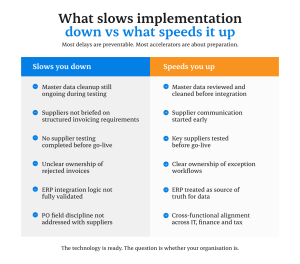
What helps implementation move faster
- Clear understanding of regulatory scope
- Clean master data before integration
- Early supplier communication and testing
- Cross-functional ownership established
- ERP treated as the source of truth
For a structured approach, see our e-invoicing readiness checklist.
The real mindset shift
E-invoicing implementation is not a technology project. The technology works. It’s fast, reliable, and connectivity is a solved problem.
What takes time is the quality of your data, the discipline of your supplier relationships, and your operational readiness.
Organisations that treat e-invoicing as a data and process transformation stabilise faster and achieve higher automation rates.
The technology is ready. The question is whether your organisation is.
Not sure how ready you are?
Start with our e-invoicing readiness assessment. It’s the fastest way to identify gaps and build a practical plan before deadlines arrive.
Frequently askedquestions
The technical configuration - connectivity, PEPPOL setup and platform activation - can typically be completed in a day or less. However, the overall implementation timeline depends on organisational readiness, including master data quality, ERP integration complexity, supplier onboarding and internal process alignment. These preparation activities are what determine the full timeline.
The most common cause of delays is poor master data quality. Missing or inconsistent VAT numbers, incorrect legal entity names and duplicate supplier records lead to invoice validation failures and manual review queues. Supplier behaviour, such as incorrect use of PO number fields, is the second most common issue.
No. Connecting to PEPPOL and configuring e-invoicing transmission is straightforward and fast. The harder part is ensuring your organisation’s data, processes and supplier relationships are ready for the structured validation that follows. Connectivity is technical. Readiness is operational.
Finance teams should start by reviewing their ERP as the source of truth for master data, confirming that organisation details, supplier records and legal entity identifiers are complete and accurate. Understanding which regulatory mandates apply and engaging IT, tax and AP teams early are also critical first steps.
PEPPOL transmits exactly what the supplier provides without validating the content. If suppliers enter incorrect values in PO number fields, use free-text fields instead of dedicated fields, or submit invoices with missing identifiers, invoices are misrouted or require manual intervention. Early supplier education and testing significantly reduce exception rates at go-live.